
Overview
Team & Permissions
Control who sees what across your events. Assign Super Admins, Admins, Team Members, or External Collaborators and fine-tune what each role can do.
Permission Levels
Section titled “Permission Levels”You’re co-hosting a dinner with another firm. They need to manage their half of the guest list. But they should never see your LP database or your other events.
Your head of IT needs to control who’s on the account. Your head of Events needs access to everything but shouldn’t be managing team membership. Your EA works across all events. Your managing partner just wants to glance at who’s confirmed for Thursday.
Four different needs. Gatsby handles each with a different permission tier.
Super Admin
Everything an Admin can do, plus control over team-level permissions. Super Admins decide what other roles are allowed to do.
What Super Admins can do:
- Everything Admins can do (full platform access)
- Add and remove team members, including other Super Admins
- Access the Super Admin Settings tab in Team Settings
- Toggle whether Admins, Team Members, and External Collaborators can add/remove team members
- Toggle whether other roles can edit linked email account settings
- Override permissions for individual team members directly from the Team Members table
- View per-user permission status columns on the Team Members page
Best for: IT leads, account owners, anyone who needs to control what other roles can do.
Admin
Full access to everything. All events, all contacts, all settings. No access requests needed.
What Admins can do:
- Access any event or contact without requesting permission
- Manage org-level settings, security, email permissions, and integrations
- Add and remove team members (unless restricted by a Super Admin)
- Edit linked email account settings (unless restricted by a Super Admin)
- Change other users’ permission levels (except Super Admins)
What Admins cannot do:
- Access the Super Admin Settings tab
- Create or demote Super Admins
- See the per-user permission columns on the Team Members page
Best for: Event leads, ops managers, platform owners who don’t need to manage team-level permission policies.
Team Member
Can see all events but must request access to edit them. Full access to the contact database. Can create new events.
What Team Members can do:
- View all events in the org
- Request access to edit specific events
- Access the full contact database
- Create new events and lists
Best for: Regional teams, marketing coordinators, EAs who work across multiple events.
External Collaborator
Only sees events they’re specifically assigned to. Cannot see your contact database, cannot see other events, and doesn’t know they exist.
What External Collaborators can do:
- View and edit their assigned events
- Add guests to assigned events (controlled by Super Admin Settings — see below)
- Edit landing pages and email templates
- Create and send campaigns (from their own email only)
- Work on seating charts
What they cannot do:
- See your contact database
- View other events in your org
- Create new events
- Remove guests from guest lists
- Send emails as other team members
- Send texts
By default, External Collaborators can create new contacts and upload CSVs inside their assigned events, but cannot search your Contacts or restore archived guests. Super Admins can broaden or restrict this — see Super Admin Settings.
Best for: Co-hosts, vendors, design agencies, partners.
Two capabilities with tighter rules
Section titled “Two capabilities with tighter rules”Most of what a role can do follows from the four roles above. Two things are gated more tightly, on purpose.
Sending SMS
Super Admins, Admins, and Team Members can send texts. External Collaborators cannot — they don’t see the SMS option in the channel picker, and the server refuses the send if they reach it another way. They can still send email campaigns.
Stricter than email, deliberately: every text costs money to send, and a bad send risks your ability to text at all. See SMS Campaigns.
Payment methods and paid add-ons
Plan & Billing is Super Admin and Admin only. Other roles don’t see the tab and can’t add a payment method, purchase an add-on, or cancel one. See Plan & Billing.
Org Roles vs. Event Roles
Section titled “Org Roles vs. Event Roles”The four permission levels above are org-wide — they set what someone can see and do across your entire account. Separately, individual events can carry their own per-event permissions that layer on top of a person’s org-wide level. There is no functional difference between an event organizer and an event collaborator. The organizer role is helpful for your team to know who the lead is on the event .
An Admin or Super Admin already has full access to every event regardless of event role. Event roles matter most for Team Members, who otherwise must request access to edit a given event — assigning an event role is how that access gets granted.
Not Everyone Needs a Login
Section titled “Not Everyone Needs a Login”Your managing partner wants to see who’s coming to Thursday’s dinner. Your caterer needs the dietary restrictions list. Your CFO wants to review the guest list before invitations go out.
None of them need to edit your event. Give them a read-only guest list view instead.
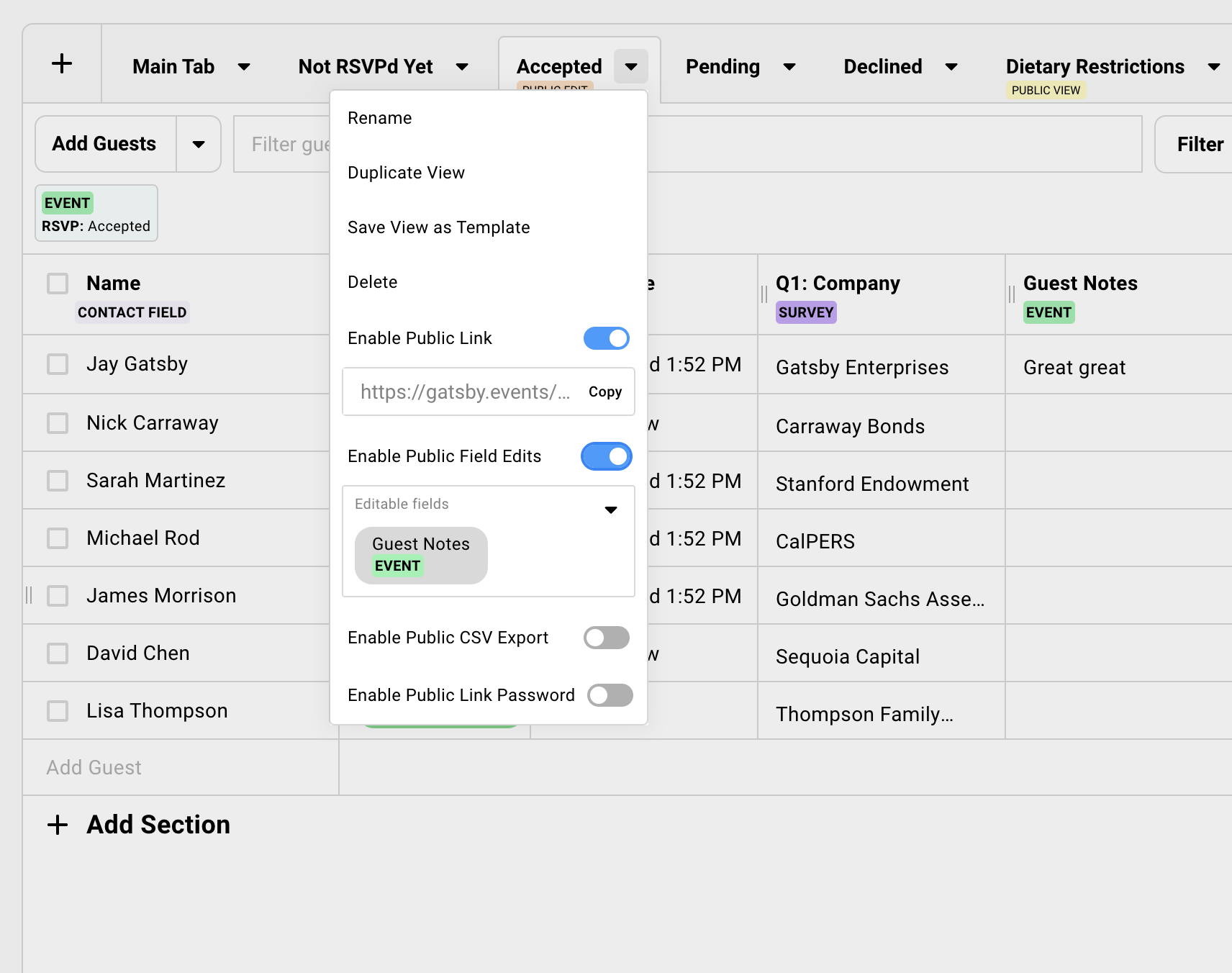
Views are shared links. No login, no password, no risk of accidental changes. They always show the current state of the list, updated in real time.
You control what’s visible. Show names and dietary needs to the caterer, hide email addresses entirely. Enable CSV export if they need to pull data into their own system.
Use read-only views for:
- Executives who want oversight without involvement
- Vendors who need specific data (catering, A/V, printing)
- Partners where full External Collaborator access is more than they need
- Anyone who just needs to see, not edit
Setting Up a Guest List View
-
Open your event’s guest list.
-
Configure a view with the columns you want visible. Hide emails if needed.
-
Click Enable Public Link and copy the public link.
-
Send the link to whoever needs access.
They’ll see current data, updated in real time, with no login required.
Common Workflows
Section titled “Common Workflows” Co-hosted Events with Partner Firms
Invite your co-host’s event lead as an External Collaborator. They upload their contacts, see the combined guest list, and help manage registration.
Your other events and contacts stay invisible to them.
Design Agencies Working on Templates
Create a sandbox event with no real contacts. Add your designer as an External Collaborator.
They build landing pages and email templates directly in Gatsby without accessing your production events or data.
Chapter Leads in Membership Organizations
Each regional chapter lead gets External Collaborator access to their city’s events. They manage their local community without seeing national membership data or other chapters’ events.
HQ admins maintain full visibility across everything.
Partner Contact Uploads via Parent-Child Events
Create a child event under your main event. Add your partner as an External Collaborator on the child only.
They upload their contacts there. Those contacts automatically sync to the parent event. The partner never sees your full guest list or other child events.
A Note on Data Security
Section titled “A Note on Data Security”External Collaborators can send emails to everyone in their assigned events. There’s no way to fully prevent email addresses from being captured if someone wanted to.
This role requires a baseline of trust. For partners where email exposure is a concern, use read-only guest list views instead. Emails can be hidden, and no login is required.
Super Admin Settings
Section titled “Super Admin Settings”Super Admins have a dedicated Super Admin Settings tab inside Team Settings. This is where you control what other permission levels are allowed to do — without changing their role.
What You Can Control
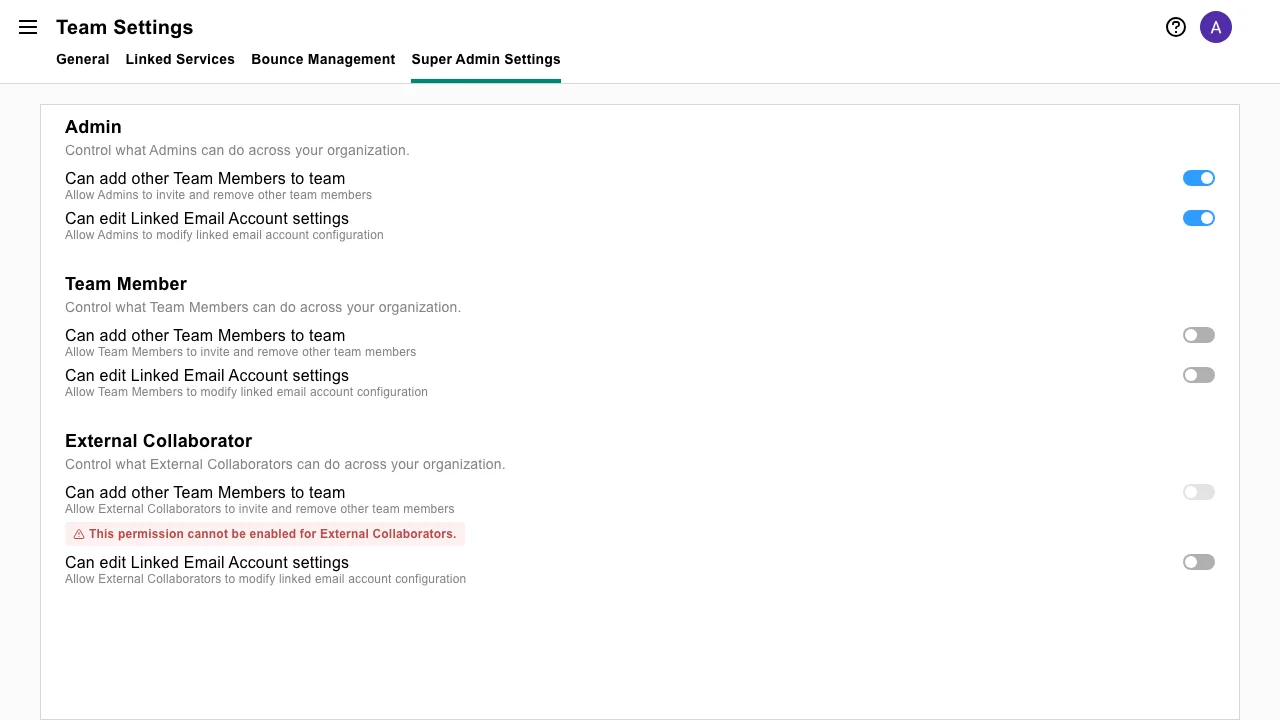
The Super Admin Settings tab shows a section for each role — Admin, Team Member, and External Collaborator — with toggles that control role-level capabilities:
- Can add other Team Members to team — Controls whether users with this role can add or remove team members.
- Can edit Linked Email Account settings — Controls whether users with this role can modify connected email account configurations and invite teammates to connect their accounts.
For External Collaborators, the “Can add other Team Members” toggle is locked off and cannot be enabled. External Collaborators should never manage team membership.
The External Collaborator section also includes an Add people to events picker that controls how External Collaborators can add guests inside the events they’re assigned to:
- Full access — External Collaborators can search your Contacts, create new contacts, upload CSVs, restore archived guests, and add sections.
- Create only (default) — External Collaborators can create new contacts, upload CSVs, and add sections. They cannot search your Contacts or restore archived guests.
- None — External Collaborators can only add new sections. They cannot create contacts, upload CSVs, search Contacts, or restore archived guests.
Existing accounts are set to Create only by default, which matches the behavior most teams already had. The Add Guests button in the event navbar, the guest list toolbar, and the inline add-row cell all update automatically to match the level you select. The same restrictions are enforced on the backend, so the level cannot be bypassed by API.
How Changes Apply
When you change a toggle and save, a confirmation dialog explains that the change will apply to all existing users with that permission level.
For example, toggling “Can add other Team Members” to off for Admins means every Admin on your account immediately loses the ability to add or remove team members. Only Super Admins retain that ability.
Per-User Overrides
Super Admins can also override permission settings for individual team members directly from the Team Members page.
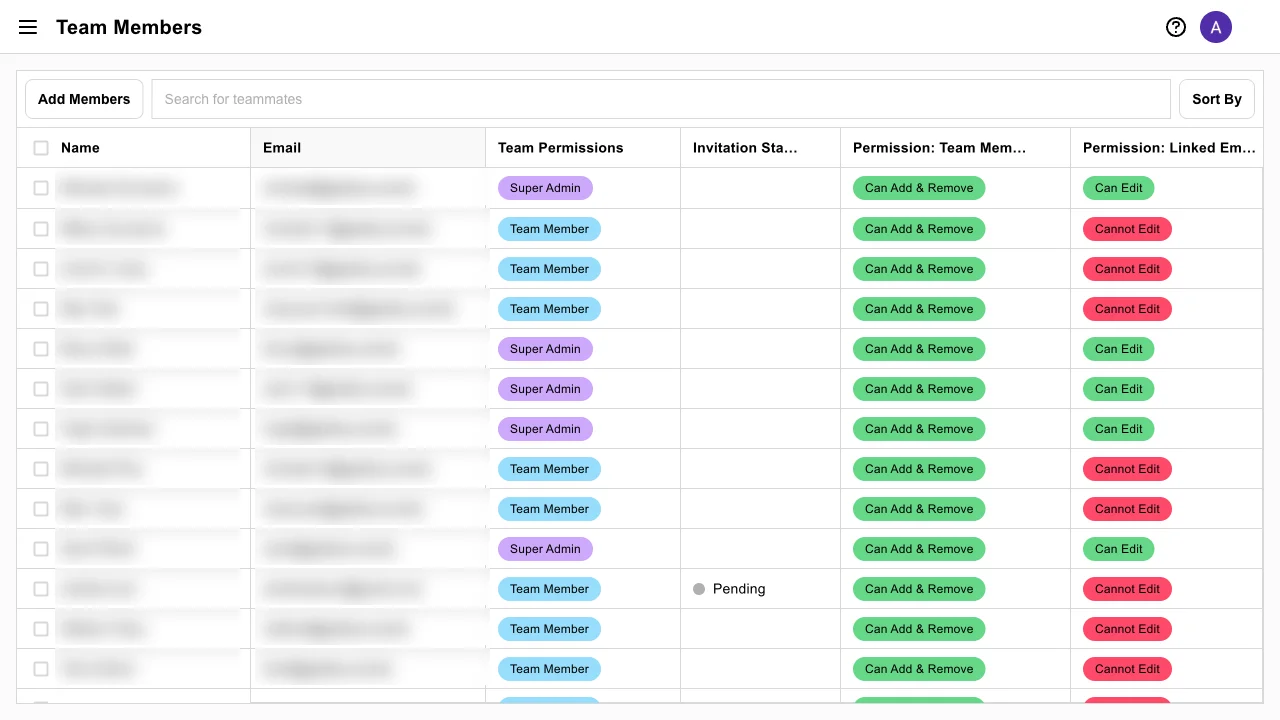
Two additional columns are visible only to Super Admins:
- Permission: Team Members — Shows “Can Add & Remove” (green) or “Cannot Add & Remove” (red)
- Permission: Edit Linked Email Settings — Shows “Can Edit Linked Emails” (green) or “Cannot Edit Linked Emails” (red)
Click any value in these columns to change it for that specific person. This lets you grant or restrict individual team members independently from the role-level defaults you set in Super Admin Settings.
Adding Team Members
Section titled “Adding Team Members”Add team members and External Collaborators from the Team Members page in your account settings.
Adding a New Team Member
-
Navigate to Team Members from your main dashboard.
-
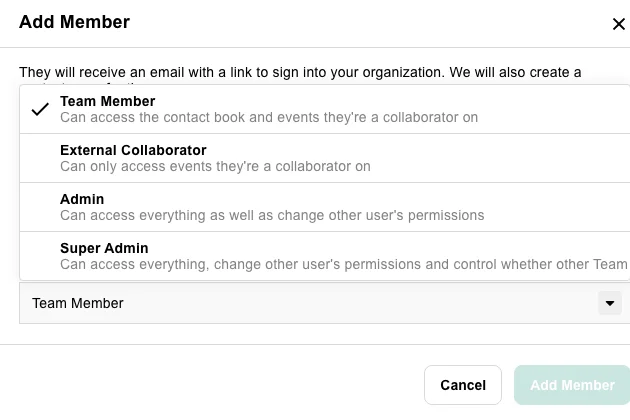
Click Add Member.
-
Enter their email address and name.
-
Choose their permission level: Team Member, External Collaborator, Admin, or Super Admin.
-
They’ll receive an email invitation to join your org.
When a New Team Member Can't Get In
If someone you’ve added can’t find their invitation or can’t sign in, there’s no need to remove and re-add them. Two ways in from the Gatsby login screen:
- Resend the invite. The login screen has an option to resend your team invite.
- Reset the password. Going through the forgot-password flow also gets a newly added team member into the account.
Changing a Team Member's Role
From the Team Members page, find the person and use the dropdown under Team Permissions to change their role.
- Admins can promote Team Members to Admin or change roles among non-Super Admin levels.
- Super Admins can assign or remove any role, including Super Admin.
- Admins cannot demote or modify Super Admins.
Adding External Collaborators from an Event
You can also add External Collaborators directly from an event.
Open the event, click the three-dot menu or the + button, and select Add Collaborators. This adds them to your org as an External Collaborator with access to that event.
Common Questions
Section titled “Common Questions” What's the difference between Super Admin and Admin?
Both have full access to events, contacts, and settings. The difference is governance.
Super Admins can access the Super Admin Settings tab to control what other roles are allowed to do — like whether Admins can add team members or edit linked email settings. Admins cannot see or change these controls.
Super Admins can also create other Super Admins and see per-user permission columns on the Team Members page. Admins cannot.
Can an Admin demote a Super Admin?
No. Only Super Admins can change another Super Admin’s role. Admins cannot modify Super Admin users.
What happens if I restrict Admins from adding team members?
If a Super Admin toggles “Can add other Team Members to team” to off for the Admin role, all Admins will lose the ability to add or remove team members. The Add Members button and remove controls will be hidden for them. Only Super Admins will retain those abilities.
All other Admin capabilities — accessing events, contacts, settings, integrations — remain unchanged.
Can External Collaborators send emails?
Yes. They can send campaigns from their own connected email account to guests in their assigned events. They cannot send as other team members.
Can External Collaborators add or upload contacts to events?
It depends on the Add people to events setting under Super Admin Settings → External Collaborator.
- Full access lets them search your Contacts, create new contacts, upload CSVs, restore archived guests, and add sections.
- Create only (the default) lets them create new contacts, upload CSVs, and add sections, but they cannot search your Contacts or restore archived guests.
- None restricts them to adding new sections only.
Pick the level that matches how much access your outside collaborators need. If you want a partner to bring their own list to your event without ever seeing your contact database, Create only is the right setting.
Why can't I edit some fields on a guest profile?
Some edits to guest profiles are managed at the team level, so they aren’t available to every user on the account. External Collaborators are the most limited. If you need a change you can’t make yourself, ask an Admin or Super Admin on your team.
Why can't I see notification settings?
Notification settings are hidden from External Collaborators. If you’re working on another organization’s account as an External Collaborator and want your notifications changed or turned off, contact Gatsby support.
Can I hide email addresses from External Collaborators?
Not fully. External Collaborators can see and email guests within their events.
If you need to share guest data without exposing emails, use a read-only guest list view with the email column hidden.
Can I control who sends from which email address?
Yes. Contact support to enable strict sending permissions.
Once enabled, Admins control which team members can send from which connected email accounts. Team Members only send from addresses they’ve been explicitly granted. External Collaborators can only send as themselves.
Granting yourself or a teammate access to a connected account. With strict sending permissions on, a new joiner sees every account they aren’t on the allow list for grayed out in the send-from dropdown, with an info icon that says how to get access. They can’t send from those accounts until they’re added. Any admin on the team can add them without contacting support:
- Go to Team Settings » Linked Services.
- Click the three-dots menu next to the account you want to send from.
- Add the person to the allow list.
- Have them refresh their Gatsby browser tabs and try again.
Use case: The Partner’s EA sends dinner invitations from the Partner’s address while other team members cannot.
How should small teams set up permissions?
Small, trusted teams often make everyone an Admin or Super Admin. No access requests, everyone works on any event.
As your team grows, designate one or two Super Admins to manage team-level policies, keep most internal staff as Admins or Team Members, and add External Collaborators for outside partners.
Can Gatsby support change my permission level for me?
No. We stay out of changing permissions on customer accounts, for the same security reasons you’d expect. Permission changes are made by your own team: any Admin or Super Admin on your account can do it from the Team Members page in seconds, and that’s always the fastest route.
The exception is an account with no active Admin or Super Admin left. Someone left the firm without handing over. In that case, contact us and we’ll walk you through the approval process, which requires a written request from a C-level executive at your organisation before we can make any change.
How do I give someone view-only access?
Use a guest list view instead of adding them as a team member. From Guests » view menu (dropdown icon), configure a view with the columns you want visible, click Enable Public Link, and send them the link. No login needed.